
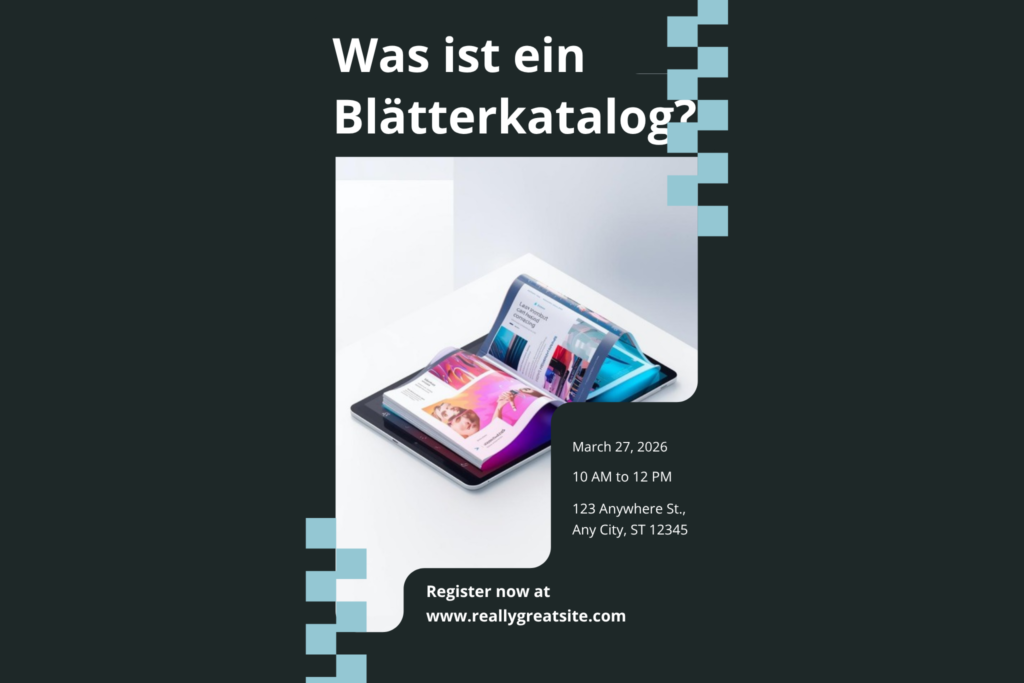
What Is a Flipbook? Definition and Significance
A flipbook is a digital catalogue that can be browsed in a web browser just like a printed magazine. Unlike a static PDF, a flipbook offers interactive features such as clickable links, embedded videos, shopping cart functionality, and integrated analytics. The term is used interchangeably with online flipbook, digital catalogue, flipbook catalogue, or e-catalogue.
A professional flipbook by flipaio goes live within 5 business days of receiving your print-ready PDF. The full-service package includes layout implementation, interactive elements, shop integration, and GDPR-compliant hosting in Germany.
Flipbook vs. PDF: The Key Differences
Many companies still distribute their product catalogues as PDF files via email or for download. A flipbook goes significantly further and offers advantages that a static PDF simply cannot deliver:
| Feature | PDF File | Flipbook |
|---|---|---|
| Presentation | Static document, scrolling | Realistic page-turning animation, like a real magazine |
| Interactivity | None or limited | Clickable links, videos, animations, shopping cart |
| Analytics | No user data | Page views, time spent, click behaviour |
| Mobile Use | Often hard to read on smartphones | Responsive, optimised for all devices |
| Loading Time | Entire document is downloaded | Page-by-page loading, instantly available |
| SEO Visibility | Very limited | Content indexable and SEO-optimisable |
| Updating | Create and redistribute new PDF | Individual pages can be updated at any time |
| Hosting | On your own server or via email | Cloud-based, shareable via link |
How Does a Flipbook Work?
Creating a flipbook follows a clear process. At flipaio, the workflow looks like this:
- Provide print-ready PDF: You supply your existing PDF file — whether it is a product catalogue, brochure, lookbook, or magazine.
- Professional implementation: The flipaio team optimises your layout for digital presentation, adds interactive elements, and configures the desired features.
- Integrate interactive elements: Clickable product links, embedded videos, image galleries, or a direct shopping cart integration turn your catalogue into a sales tool.
- Hosting and deployment: Your flipbook is hosted on GDPR-compliant servers in Germany and accessible via a simple link.
- Activate analytics: After publication, you can see in real time which pages are viewed for how long and where your readers click.
Who Uses Flipbooks? Industries and Use Cases
Digital flipbooks are used across all industries — wherever companies want to present products or services visually. The most common applications include:
- Retail and e-commerce: Product and promotional catalogues linked directly to the online shop. Customers can browse and add items to their cart instantly.
- Furniture and interior design: Lookbooks and inspiration catalogues that showcase room concepts and product worlds.
- Mail order: Digital main catalogues as a complement or replacement for the printed catalogue — with the same tactile feel but without printing and shipping costs.
- Industry and B2B: Technical product catalogues that present complex ranges clearly and link to data sheet downloads.
- Hospitality and hotels: Digital menus, room catalogues, and event brochures.
- Medical technology: Product overviews for medical devices and consumables, often linked to regulatory information.
An overview of the industries in which flipaio is active can be found on the industry page.
Advantages of a Flipbook Over Print
Switching from printed catalogues to digital flipbooks delivers measurable benefits for businesses. According to an analysis of our client projects, companies report on average a 3x higher dwell time compared to static PDF catalogues.
- Cost reduction: Printing, paper, and shipping costs are eliminated entirely. A digital brochure is created once and available indefinitely. With rising paper prices, the cost advantage grows ever greater.
- Instant updatability: Price changes, new products, or seasonal adjustments go live within hours — not after weeks of print lead time.
- Measurability: With integrated analytics features, you can see exactly which pages your customers read, how long they stay, and where they click. This data is invaluable for your sales team.
- Reach: A flipbook can be shared via link — through email, social media, newsletters, or QR codes. No physical shipping, no geographical boundaries.
- Sustainability: No paper consumption, no CO2 from printing and logistics. Companies that switch to digital catalogues demonstrably improve their environmental footprint.
- Interactivity: Embedded videos, image galleries, clickable hotspots, and shopping cart integration transform a passive reading experience into an active shopping experience.
- SEO visibility: Unlike a PDF, a flipbook can be indexed by search engines. With the right SEO strategy, your catalogue can be found via Google.
Full-Service vs. Self-Service: Which Approach Suits You?
There are two fundamentally different approaches to creating flipbooks on the market:
Self-service tools (e.g. Yumpu, FlipHTML5) offer a platform where you upload your PDF and generate a flipbook yourself. The advantage: fast and often inexpensive. The drawbacks: limited design options, no individual customisation, and the quality depends entirely on your own resources.
Full-service providers like flipaio handle the entire process — from layout optimisation to interactive element integration to GDPR-compliant hosting. You provide the print-ready PDF, flipaio delivers the finished flipbook. The result is a professional digital product that represents your brand and works as a sales tool.
| Criterion | Self-Service Tool | Full-Service (flipaio) |
|---|---|---|
| Effort for you | High (do everything yourself) | Minimal (provide PDF, done) |
| Quality | Depends on your own skills | Professional, brand-consistent |
| Individual customisation | Limited (templates) | Fully customised |
| Shop integration | Partially possible | Seamlessly integrated |
| GDPR hosting | Often US servers | Servers in Germany |
| Support | Self-service / community | Dedicated contact person |
| Time required | Hours to days (your own work) | 5 business days (flipaio does the work) |
What Does a Flipbook Cost?
The cost of a flipbook depends on the chosen model. Self-service tools often offer free basic versions with limited features and advertising. Professional self-service licences typically start at 20–50 euros per month.
A full-service flipbook from flipaio follows a transparent pricing model based on page count, desired features, and hosting options. The advantage: you pay for a finished result, not for a tool you have to operate yourself.
What matters is not the price alone, but the return on investment: How much do you save on printing costs? How much more revenue do you generate through better measurability and higher interaction? Companies that switch from print to digital typically report cost savings of between 40% and 70% compared to their annual print budget.
Creating a Flipbook: Step by Step with flipaio
Want to create your own flipbook? With flipaio, it works in just a few steps:
- Get in touch: Describe your project — page count, desired features, industry, and target audience.
- Provide print-ready PDF: Supply your existing catalogue PDF. Tips for optimal PDF preparation can be found in our practical guide.
- Consultation: The flipaio team discusses with you the desired interactive elements, corporate design requirements, and technical specifications.
- Implementation: flipaio creates your flipbook — including layout optimisation, interactive elements, and analytics setup.
- Review and approval: You review the result and provide feedback. Changes are implemented promptly.
- Go live: Your flipbook goes online — hosted on GDPR-compliant servers in Germany, accessible via a unique link.
Key Features of a Modern Flipbook
A professional flipbook offers far more than just a digital copy of your printed catalogue. Here are the most important features at a glance:
- Page-turning animation: Realistic page-flip effect that conveys the feel of a real catalogue.
- Full-text search: Readers can search specifically for products, terms, or article numbers.
- Clickable hotspots: Areas on the page that lead to product pages, videos, or further information when clicked.
- Video integration: Embedded product videos directly within the catalogue page increase engagement and conversion.
- Shopping cart function: Direct transfer of products to the shopping cart of your online shop.
- Analytics dashboard: Real-time data on page views, dwell time, click behaviour, and bounce rates.
- Responsive design: Optimised display on desktop, tablet, and smartphone.
- Multilingual support: Management of multilingual catalogue versions on a single platform.
- Social sharing: Readers can share individual pages or the entire catalogue via social media.
- Accessibility: Accessible catalogues that meet the requirements of the European Accessibility Act.
SEO and Visibility: How Flipbooks Rank on Google
A common problem with classic PDF catalogues: Google can only index their content to a limited extent. A professionally created flipbook solves this problem because the content is delivered as HTML pages and can be optimised for search engines.
Key SEO aspects for flipbooks:
- Indexable text content: Product descriptions and catalogue texts are captured by Google.
- Structured data: Schema markup (e.g. Product, Organization) improves presentation in search results.
- Fast loading times: Optimised loading of individual pages rather than the entire document.
- Mobile optimisation: Google evaluates mobile-friendliness as a ranking factor.
Learn more about SEO optimisation for online catalogues in our comprehensive guide.
GDPR and Data Protection for Flipbooks
When using digital catalogues, data protection plays a central role — particularly for companies within the EU. Here is what you need to consider:
- Hosting location: Ensure that your flipbook is hosted on servers in Germany or the EU. flipaio hosts exclusively on German servers.
- Cookie consent: If analytics tracking is used, a GDPR-compliant cookie banner must be integrated.
- Data processing: Transparency about which user data is collected and how it is processed.
- Data processing agreement (DPA): When working with a service provider like flipaio, a DPA is signed.
Further details on GDPR and hosting can be found in our specialist article.
Flipbook Trends 2026: What Comes Next?
The market for digital catalogues is evolving rapidly. These trends are shaping the industry in 2026:
- AI-powered personalisation: Catalogues that display individual product recommendations based on user behaviour. More on the role of AI in catalogue creation.
- Shoppable catalogues: The line between catalogue and online shop is blurring. Products can be purchased directly from the catalogue.
- Omnichannel integration: Flipbooks are seamlessly integrated into omnichannel strategies — via QR codes in print materials, embedding on websites, or linking in social media.
- Video-first content: More and more catalogues integrate video content directly into the page view.
- Accessibility as standard: The European Accessibility Act (from June 2025) makes accessible digital catalogues mandatory.
Conclusion: Why Your Next Catalogue Should Be a Flipbook
Flipbooks combine the best of both worlds: the familiar feel of a printed catalogue with the advantages of digital technology. They are more cost-effective than print, deliver measurable results, and offer your customers a contemporary shopping experience.
Whether retail, B2B, or mail order — companies that invest in digital flipbooks gain reach, measurability, and flexibility. With a full-service provider like flipaio, you also save internal resources and receive a professional result.
Ready for your first flipbook? Contact flipaio and find out how your catalogue can be online in 5 business days.
Frequently Asked Questions (FAQ)
What is a flipbook?
A flipbook is a digital catalogue that can be browsed in a web browser just like a printed magazine. It offers interactive features such as clickable links, videos, shopping cart integration, and analytics — making it far more than a simple PDF.
How do I create a flipbook?
You can either create a flipbook yourself using a self-service tool or commission a full-service provider like flipaio. With flipaio, you supply your print-ready PDF, and the team creates your professional flipbook within 5 business days.
What does a flipbook cost?
Costs vary depending on the provider and scope of services. Self-service tools start from approximately 20 euros per month. Full-service solutions like flipaio are based on page count and desired features — with typical cost savings of 40–70% compared to print.
Is a flipbook GDPR-compliant?
Yes, provided the provider hosts on EU servers and has a transparent data protection concept. flipaio hosts exclusively on German servers and signs a data processing agreement (DPA) with every client.
Can I use my existing PDF catalogue as a flipbook?
Yes. Most flipbooks are based on existing print-ready PDFs. flipaio optimises your existing layout for digital presentation and adds interactive elements. Tips for optimal preparation can be found in our PDF conversion guide.
